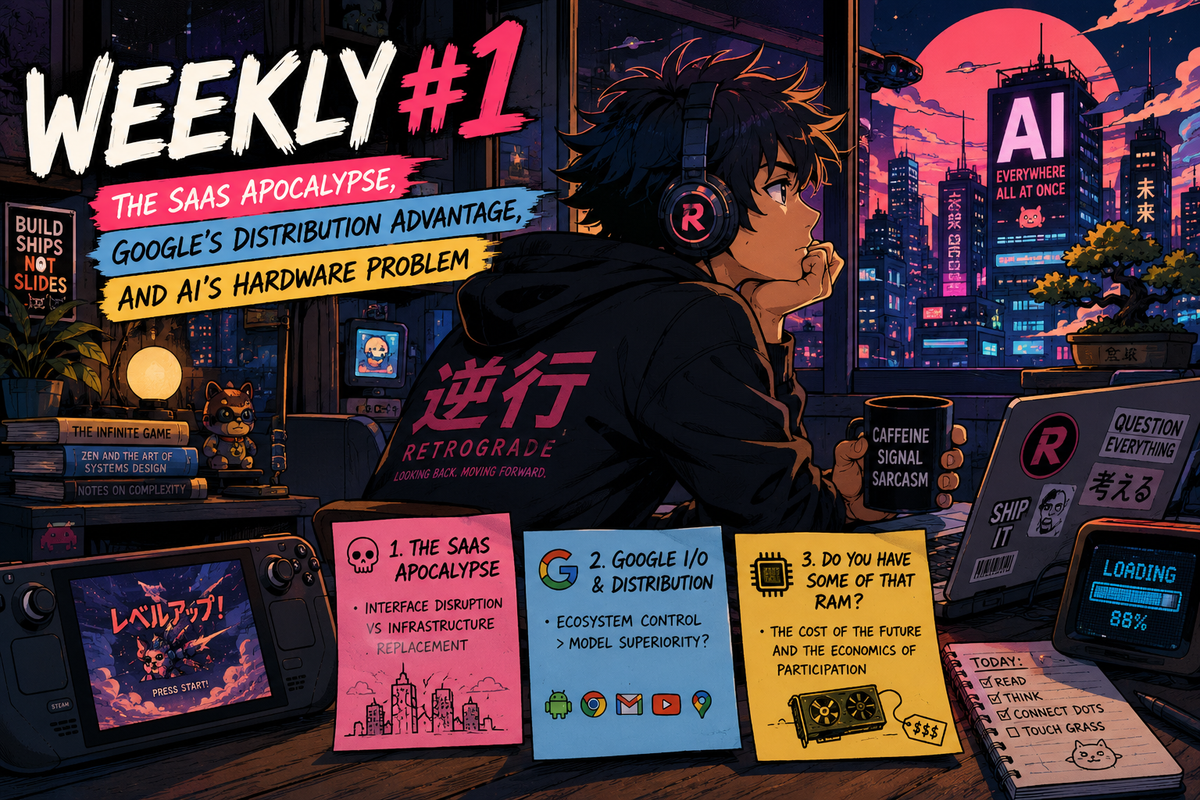
Weekly #1 — The SaaS Apocalypse, Google's Distribution Advantage, and AI's Hardware Problem

Alright, first post and it's already late.
One day behind my intended Friday publishing schedule.
Whoops.
That's life when you're working at a frontier AI lab and trying to start a technology blog from scratch.
So here we fucking go.
I’m terminally online. I spend a potentially unhealthy amount of time reading, listening to, and mentally cataloging the latest discourse surrounding technology, AI, enterprise systems, consumer gadgets, internet culture, and the broader digital world we all increasingly seem trapped inside together.
These weekly posts are essentially an attempt to process some of that noise in public and identify which signals actually feel meaningful underneath it all.
This week I want to talk about:
- The so-called "SaaS apocalypse" and whether AI is actually going to kill software
- Google I/O, Gemini, and why distribution may matter more than models
- The rising cost of hardware and what that means for broader AI adoption
Let's get into it.
1. The SaaS Apocalypse
There's a growing narrative floating around enterprise technology circles right now that AI is going to completely kill SaaS as we currently understand it.
Personally, I think it's overstated.
And that's coming from someone who works at a frontier lab that's actively building more functionality around the models themselves.
Am I fascinated by where those product strategies are headed?
Absolutely.
Do I think they end SaaS as we know it?
No.
Do I think they change it?
Of course.
I think people are mistaking interface disruption for infrastructure replacement.
This isn't the first time the industry has collectively convinced itself that a new interface layer would eliminate everything that came before it. We saw versions of this during the transition from command lines to GUIs, desktop software to browsers, browsers to mobile apps, and on-prem infrastructure to cloud computing.
What usually happens instead is that the older layer becomes infrastructural while the new layer becomes experiential.
That feels much closer to what's actually happening with AI right now.
Yes, AI agents may increasingly become the primary way humans interact with software. But underneath all of that you still need systems of record, orchestration layers, permissions, governance, workflows, integrations, data models, observability, and all the other deeply unsexy realities that enterprise software has always depended on.
Ironically, AI may actually increase the importance of good software infrastructure because now machines are operating those systems at scale instead of just humans.
The interfaces are changing.
The underlying systems are not disappearing nearly as quickly as people seem to think they are.
And while I could probably write an entire post on this, let's not forget something:
Societies tend to move at the pace of their most resistant participants.
That's not a political statement. It's an observation about human nature.
Now apply that to technology.
Enterprise transformation at massive scale is incredibly hard.
AI will absolutely accelerate parts of it.
But the systems underneath those businesses weren't designed for machine-native operation because there was never a reason for them to be.
So I'll leave this section with a question:
Is SaaS actually headed for an apocalypse?
Or will the billions—if not trillions—of dollars invested in today's software empires do what every major technology stack before them has done:
Adapt, reposition, and become critical infrastructure for the next experiential layer?
2. Google I/O and the Power of Distribution
Okay yes, technically Google I/O was ten days ago.
Whatever.
It's my blog and I still have thoughts.
My biggest takeaway from Google I/O wasn't Gemini.
It was the growing possibility that consumers may soon stop caring which model they're using altogether.
I think a lot of the AI discourse right now remains overly focused on models while underestimating the importance of ecosystem control and deployment surfaces.
Google already has...
- Android
- Chrome
- Search
- Gmail
- Maps
- Workspace
- YouTube
That's an utterly absurd amount of distribution.
Which means Google doesn't necessarily need AI to arrive as some dramatic standalone product category.
They can instead weave it into billions of existing consumer touchpoints slowly, iteratively, and almost invisibly.
Honestly, I think that's probably the smarter strategy.
Most consumers do not actually want to radically change how they interact with technology every few years. They want familiar interfaces that gradually become more capable over time, ideally at a pace where they barely notice the transition happening at all.
Which is also why the reporting surrounding Apple potentially integrating Gemini into iOS—or even offering some form of BYOM (Bring Your Own Model) future—is so fascinating to me.
Because if Apple becomes willing to orchestrate external intelligence layers instead of insisting on building every model internally, that suggests a future where consumers may not even know which models they're using anymore.
Power users will care.
People like me will absolutely care.
We'll benchmark them, argue about them, switch between them, and pick different models for different tasks.
Most people won't.
For the average user, the model itself becomes abstracted behind the ecosystem.
And if that happens, distribution starts mattering even more than raw model capability.
There's also something weirdly consistent about Google's long-term strategy here.
People talk about AI like it suddenly appeared out of nowhere over the past few years, but Google has been trying to ingest, organize, structure, and retrieve human knowledge for decades now.
Search.
Maps.
Gmail.
Google Books.
YouTube.
The entire company has basically been one long-running attempt to index reality itself.
AI increasingly feels less like a pivot and more like the next interface layer on top of that original mission.
3. Do You Have Some of That RAM?
The AI industry keeps talking about a future filled with ambient intelligence, AI companions, local inference, wearable computing, multimodal systems, and increasingly personalized digital experiences.
Cool.
And they seem very excited about the future.
I'm increasingly interested in the invoice.
The problem is that future also increasingly assumes consumers can actually afford the hardware required to participate in it.
And right now, that assumption feels a little shaky.
RAM prices are rising.
GPUs remain absurdly expensive.
Gaming handhelds are creeping upward in price.
Even companies like Valve and Nintendo—some of the last remaining hold outs—have caved to broader hardware pressures and raised their prices.
As someone who has mostly existed somewhere between "Nintendo/iPhone gamer" and "maybe I should finally become a real PC gaming person," this stuff matters more to me than it probably should.
I've been circling the Steam Deck ecosystem for a while now.
Conceptually, it's almost exactly the kind of device I should love:
- Portable
- Flexible
- Slightly nerdy
- Highly customizable
- Weirdly charming
But now that the pricing has pushed into the $800+ territory, suddenly the psychological math changes.
And I don't think I'm alone in that.
There's a broader tension emerging where the technology industry increasingly wants AI woven throughout everyday life while simultaneously making the cost of modern computing harder for average consumers to justify.
Historically, technologies only truly reshape society once they become boringly accessible:
- Electricity
- Televisions
- Internet access
- Smartphones
- Streaming
AI still feels oddly infrastructurally elite by comparison.
And until the economics of participation improve, I'm not entirely convinced broader consumer adoption unfolds quite as seamlessly as some people currently seem to expect.
The Pattern Beneath the Noise
All three stories this week are really about the gap between capability and adoption.
The SaaS conversation assumes AI can replace existing systems.
The Google conversation assumes the best model wins.
The hardware conversation assumes consumers can easily participate in the future we're building.
History suggests capability is rarely the thing that decides the outcome.
Infrastructure matters.
Distribution matters.
Economics matter.
The technologies that ultimately reshape society are rarely the most impressive ones.
They're the ones that become widely democratized, accessible enough, affordable enough, and integrated enough that people eventually stop noticing them.
That's what I'm watching for.
Not when AI becomes more capable.
The more interesting question is when it becomes boring.
Because historically, that's when the real transformation sets in.