
Weekly #5 - The Path of LESS Resistance

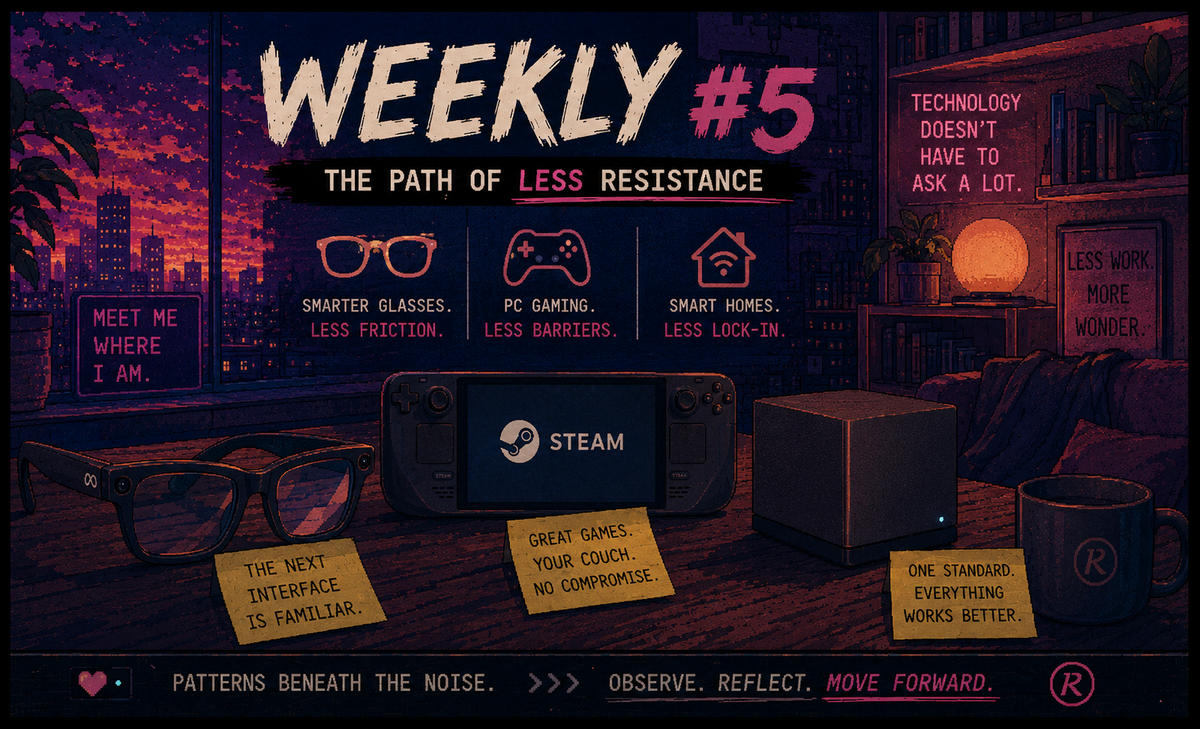
Technology has a habit of trying to change us.
This week, I noticed something a little different.
We're looking at another round in the smart glasses race, Valve's attempt to bring PC gaming into the living room, and one of the most important smart home updates you've probably never heard of.
On the surface, these stories don't have much in common.
But underneath them all is the same pattern.
Meta is making smart glasses a little less intimidating and a little more approachable. Valve is trying to make PC gaming feel less like building a computer and more like picking up a controller. Matter is making smart home devices work together regardless of whose logo is stamped on the box.
Different companies.
Different products.
The same goal.
Lower the barrier to entry.
Because the reality is that no matter how impressive the technology becomes, people won't adopt it if it asks too much of them.
The technologies that endure aren't always the ones with the biggest breakthroughs.
They're the ones that quietly fit themselves around the lives we're already living.
Let's get into it.
Story #1 - The Slow March to Your Face
Just when I thought I might get a week or two off from writing about smart glasses, Mark Zuckerberg went and responded to Snap's launch of Specs with yet another pair of Meta glasses.
We're doing this now.
Silicon Valley has apparently decided that the next great computing platform sits somewhere between our ears.
Meta's latest glasses are interesting for what they aren't. They drop the Ray-Ban branding, come in at a much friendlier price point, and avoid trying to be some all-singing, all-dancing augmented reality headset. They're simpler. Less ambitious. More approachable.
That might be the smartest thing about them.
Remember when Facebook became Meta because the metaverse was supposedly the future? Fast forward a few years and that grand vision has quietly shrunk from immersive virtual worlds to... putting AI in a pair of sunglasses.
Honestly? I don't think they're wrong.
The idea of wearing computers on our faces still feels a little dystopian to me. I'm actively trying to spend less time staring at screens, not find new ways to keep the internet permanently attached to my eyeballs.
But history has a funny way of making the strange feel ordinary.
Before the iPhone, staring at a slab of glass in public would've looked bizarre. Before the Apple Watch, wearing a tiny computer on your wrist felt like something from a sci-fi convention. Today, both are completely unremarkable.
Maybe glasses are next.
What's interesting isn't that companies are racing toward AR. It's that they're beginning to realize they have to meet people where they already are. Eyewear isn't a new behavior. Millions of people put on glasses or sunglasses every single morning without thinking about it. The technology is adapting itself to an existing habit instead of asking us to invent a new one.
That's a much more believable adoption curve.
The reality is that today's smart glasses fall into one of two camps.
They're either the dumbest consumer technology product you can buy—sorry, Snap—or they're genuinely neat, like Meta's live translation, hands-free photos, calls, messaging, and music.
The problem is that "neat" isn't enough.
Almost everything Meta's glasses do today can already be accomplished with the combination of an iPhone and a pair of AirPods. Maybe not quite as elegantly, but certainly well enough that I don't find myself thinking, I need another device for this.
That's the hurdle.
Every successful consumer device has crossed a threshold where it stopped being an accessory and started becoming the best—or only—way to do something.
The smartphone replaced half a dozen things we carried every day. The smartwatch made notifications, payments, and fitness tracking more immediate than reaching into your pocket.
Smart glasses haven't had that moment yet.
They need to deliver an experience that simply isn't possible with the devices already in our pockets, on our wrists, or in our ears. When that happens, this category stops being an interesting experiment and starts becoming inevitable.
And yes, I'll happily put this prediction in writing.
If Apple ships a compelling pair of AR glasses that feel more Apple Watch than Vision Pro, I'll probably be one of the first people in line.
Until then, we're watching an entire industry patiently negotiate with human habits instead of trying to bulldoze them.
Ironically, that's probably exactly how they'll win.
Story #2 - Steam Powered
Can we just take a moment to appreciate Valve's URL?
steampowered.com
It's simple. It's nerdy. It's perfect.
I also desperately want to like the Steam Machine.
Partly because I think the name is wonderfully bland, but mostly because I've always been PC-curious.
I grew up on Nintendo and Sega. I somehow skipped Xbox, PlayStation, Call of Duty, Grand Theft Auto, and most of the blockbuster PC gaming world entirely. It's one of those corners of technology that I've always admired from a distance without ever making the leap.
That's exactly the leap Valve seems to be trying to shrink.
The Steam Machine isn't trying to replace your custom-built gaming rig. It's trying to bring PC gaming into the living room with an experience that feels comfortingly familiar to anyone who's ever owned a console.
And I think that's genuinely cool.
Is it expensive? Absolutely.
Is it still infinitely less intimidating than researching motherboards, GPUs, CPUs, RAM, power supplies, cooling systems, and spending an entire weekend pretending you know how thermal paste works?
Also yes.
I don't actually think the Steam Machine is for hardcore PC enthusiasts. They already have exactly what they want. If anything, I could see this becoming a fantastic travel companion. That little cube looks like it'd happily disappear into a carry-on, letting you bring your entire Steam library with you instead of lugging around a full desktop.
That's an interesting direction for PC gaming.
Of course, we should be critical too.
On paper, it isn't exactly a performance monster. A PlayStation 5 can still outperform it in several areas, and today's seemingly endless RAMageddon certainly isn't helping keep prices grounded.
But I also think that's missing the point.
The Steam Machine isn't trying to win a specification war.
It's trying to make PC gaming feel less like building a computer and more like sitting down on your couch after work.
That's a very different problem to solve.
Valve already has one of the most successful gaming platforms on the planet. The challenge was never the software. It was the hardware—and the expertise people assumed they needed before they could even get started.
The Steam Deck lowered that barrier for handheld gaming.
The Steam Machine lowers it again for the living room.
Neither product fundamentally changes what Steam is.
They simply ask less of the person on the other side of the screen.
There's another reason I find the Steam Machine fascinating.
Earlier this year, Xbox CEO Phil Spencer hinted at a future where the traditional console matters less than the games themselves. The implication was obvious: asking people to spend hundreds of dollars every few years—sometimes well over a thousand if you include accessories, displays, controllers, and everything else—is becoming a harder sell.
Valve almost certainly got the same memo.
The irony, of course, is that they still had to ship an expensive piece of hardware. Between the industry's ongoing RAMageddon, increasingly powerful components, and everything else driving costs upward, there was never going to be a bargain version of the Steam Machine.
So who's right?
Xbox's cloud-first future?
Valve's living room PC?
Nintendo's hybrid handheld?
Mobile gaming?
Honestly...
I think all of them.
One of the recurring themes I've stumbled into while writing Retrograde is that human nature changes remarkably slowly.
Human preferences, on the other hand, are wonderfully diverse.
Some people have dedicated gaming rooms.
Some play during their train commute.
Some squeeze in twenty minutes after putting the kids to bed.
Some won't spend more than a few dollars on a game.
Others happily spend thousands building the perfect PC.
The future of gaming probably isn't one device replacing another.
It's gaming becoming increasingly fluid—meeting people wherever they happen to be.
We've already watched this happen once.
Mobile gaming didn't kill consoles. Consoles didn't kill PCs. The Nintendo Switch didn't kill either of them. Instead, each expanded the definition of what gaming could look like for different people. Apple quietly built one of the world's largest gaming platforms by putting capable hardware in billions of pockets. Cloud gaming emerged. Handheld gaming resurged. None of these replaced the others—they simply gave people more ways to play.
Maybe that's where this industry is headed.
Not toward one dominant way to game, but toward a collection of experiences shaped around different lives, different budgets, and different preferences.
Less a battle over hardware.
More a different state of matter.
Story #3 - Home Is Where Features Matter
Speaking of matter...
Matter 1.6 just launched.
If you don't know what Matter is, congratulations. You're probably a healthier, more well-adjusted person than the rest of us.
Here's the crash course.
Matter is an open standard developed by the Connectivity Standards Alliance—a group of technology companies that somehow all agreed to cooperate for once. Their official description is that Matter is "the foundation for connected things"and that devices carrying the Matter logo should "work reliably together."
Corporate marketing speak aside, here's the version that actually matters.
Matter is a common language.
It allows smart lights, smart locks, smart plugs, thermostats, sensors, and all the other increasingly digital objects in our homes to communicate with one another regardless of who made them.
Or at least... that's been the promise.
The most interesting announcement in Matter 1.6 isn't another category of supported devices.
It's a feature called Joint Fabric.
I have to admit, that's a fantastic name.
Joint Fabric allows compatible Matter devices to participate in multiple smart home ecosystems at the same time. A light configured in Google Home can also be controlled from Apple Home. Your smart home no longer has to pledge allegiance to a single platform.
That sounds like a tiny technical detail.
I think it's one of the most important smart home features we've seen in years.
Confession time.
It took me far longer than you'd expect to embrace smart home technology. It always felt too fragile. Too fiddly. Too many apps. Too many pairing screens. Too many moments where I'd mutter, "Why doesn't this stupid thing just work?"
And to be perfectly honest...
I still don't particularly enjoy using Apple's Home app, despite spending most of my life enthusiastically living inside Apple's ecosystem.
But my wife and I are getting ready for a big move, and I'm planning to go much further with our smart home this time around.
For the first time, I actually think the technology might be ready.
That's why I find Matter so fascinating.
Ever since generative AI exploded into public consciousness in 2022, we've been conditioned to expect technology to move at breakneck speed. Every week seems to bring another model, another launch, another announcement promising to reinvent something.
Meanwhile, Matter has been doing something far less glamorous.
It has been patiently convincing competitors to cooperate.
Apple.
Google.
Amazon.
Samsung.
Countless device manufacturers.
Not because they suddenly became best friends, but because eventually everyone arrived at the same conclusion.
People don't actually want an Apple home.
Or a Google home.
Or an Amazon home.
They want their home.
They want to walk into a store, pick up a light bulb, a smart lock, or a thermostat, bring it home, and have complete confidence that it'll work with everything else they already own.
That's a remarkably human expectation.
And that's what I love about Matter.
The goal isn't to wow you with futuristic features.
The goal is to disappear.
Because the highest compliment you can pay home technology isn't that it's smart.
It's that you stopped thinking about it altogether.
If that sounds boring...
Good.
The best infrastructure usually is.
So here's my question for you.
What's one smart home annoyance you'd love to never think about again?