Weekly #4 - The Interface Strikes Back

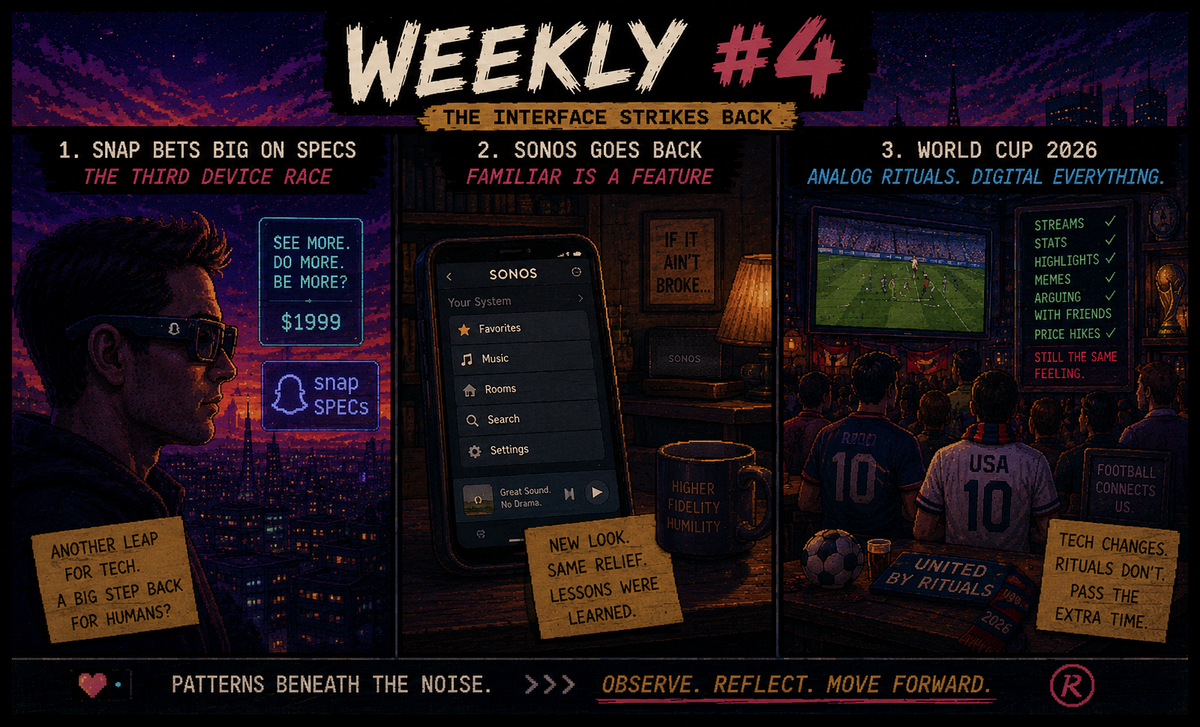
Technology evolves. Human rituals endure.
That's the idea sitting at the molten center of this week's issue.
Everywhere I look, technology companies are launching new devices, redesigning familiar apps, and searching for the next great interface that will supposedly change how we live, work, and interact with the world.
And yet when I zoom out, I keep seeing the same thing.
The same wants.
The same frustrations.
The same habits.
The same patterns repeating beneath the noise.
This week we're looking at Snap's ambitious new Specs, Sonos' surprisingly familiar app updates, and yes, sportsball in the form of the 2026 FIFA World Cup.
At first glance these stories have very little in common.
One is about augmented reality glasses.
One is about wireless speakers.
One is about twenty-two grown adults chasing a ball while millions of us irrationally convince ourselves that this year will be different.
But underneath all three stories sits the same observation.
Technology changes quickly.
Humans don't.
Or at least not nearly as quickly as the people building the technology would like.
What do all of these have in common?
Us.
Let's get into it.
Story #1 — The Third Device Problem
Everyone in tech is waiting to see who wins the race to become the "third device."
The first device is obvious: the smartphone. The second might be the little computers many of us wear on our wrists masquerading as watches. (I'm currently wearing two of them, a Garmin and an Apple Watch. Ask me later.)
The third device? That's where things get interesting.
Maybe it's still something we already have. Maybe it's a smartwatch that becomes dramatically more capable. Maybe it's an earbud. Maybe it's something entirely new.
Or maybe it's something we've been wearing for centuries: glasses.
Which brings us to Snap and their newly announced Specs.
Snap is betting big on smart glasses. More accurately, they're asking you to bet big on smart glasses. With your wallet.
And that's where things start to fall apart for me.
At more than $2,000, Specs immediately remind me of another ambitious headset-shaped object: Apple's Vision Pro.
The difference is that Vision Pro felt like Apple had pushed the limits of what was possible within the constraints of the form factor. You could disagree with the strategy, question the price, or wonder who exactly it was for, but it was difficult to argue that Apple hadn't thrown its best engineers at the problem.
Specs feel different.
Maybe it's the industrial design. Maybe it's the weight. Maybe it's the fact that every time I see them on Evan Spiegel's face my ears start hurting in sympathy.
Whatever it is, I keep coming back to the same question:
Have we learned anything from the last decade of wearable computing?
The graveyard is getting crowded.
Google Glass.
Pebble.
Jawbone.
Humane.
Rabbit.
Countless smartwatches.
Countless fitness trackers.
Countless "this changes everything" product launches that, in hindsight, changed very little.
The pattern is remarkably consistent. Technology companies keep trying to invent new human behavior.
Humans keep stubbornly refusing.
The most successful devices of the last twenty years didn't create entirely new habits. They fit themselves into existing ones.
The iPhone didn't invent communication.
AirPods didn't invent listening.
The Apple Watch didn't invent checking the time.
They reduced friction around behaviors that already existed.
That's what makes the current smart glasses race so fascinating.
The industry desperately wants there to be a next device.
Not because consumers are demanding one, but because platform companies always need a next platform.
A new device creates new ecosystems. New revenue streams. New services. New subscriptions. New opportunities to become the default gateway between humans and the digital world.
The incentives are obvious.
The consumer demand is less so.
And before anyone asks, I genuinely have no idea what the future device strategy looks like at OpenAI. Whatever hardware ambitions may or may not exist somewhere inside the company are well outside my pay grade. The rest of us learn about most of this stuff at roughly the same time everyone else does.
What I do know is that every company chasing the next device faces the same challenge.
The product has to create meaningful value that a smartphone cannot.
It has to be genuinely pleasant to wear or carry.
And it has to be affordable enough that normal people can justify owning it.
That's a surprisingly difficult combination.
Until someone solves all three, I'm not holding my breath.
Which is why Specs feel less like the future and more like another entry in a very familiar cycle.
The technology is new.
The pitch is new.
The industrial design is new.
But the underlying story is one we've seen before.
The industry wants a third device.
Human nature remains unconvinced.
Story #2 - Hey Sonos, This Sounds Familiar
Okay, this next one is admittedly niche.
Unless you're a fellow Sonos owner and amateur audiophile, in which case welcome, friend.
For everyone else, Sonos makes premium wireless speakers that sound fantastic and occasionally remind you that software can still be deeply annoying.
Despite their quirks, I'm a fan.
If you've ever wanted whole-home audio or a genuinely immersive surround sound setup, Sonos can be magical. Once everything is connected, configured, grouped, updated, reconfigured, updated again, and you've sacrificed a small offering to the Wi-Fi gods, the experience is excellent.
Which brings us to the app.
If you somehow missed it, Sonos spent much of the last year dealing with the fallout from a major app redesign that managed to anger an impressive percentage of its customer base.
Not just casual users.
The enthusiasts.
The loyalists.
The people who spent thousands of dollars filling their homes with Sonos products and spent years recommending them to friends.
In technology circles we're constantly told that innovation wins.
Move fast.
Ship new things.
Disrupt yourself before someone else does.
And yet the most interesting thing about Sonos' latest update wasn't a new feature.
It was a single word.
In a Reddit post outlining the latest beta release, Sonos highlighted what they called:
"Familiar Tabbed Navigation."
Familiar.
Not revolutionary.
Not AI-powered.
Not next-generation.
Not transformative.
Familiar.
It's a funny word to see coming from a company that built its reputation by redefining what home audio could be.
This is the same company that looked at a world full of tangled speaker wires and complicated receiver setups and essentially said:
"Hold my beer."
And for years, they delivered.
Then they tried to reinvent something else.
The interface.
And users revolted.
What Sonos discovered is something many technology companies eventually learn the hard way.
The best interfaces become invisible.
You stop thinking about them.
You stop noticing them.
They fade into the background and allow you to focus on what you actually came to do.
Listen to music.
Watch a movie.
Enjoy the experience.
The moment users start thinking about the interface again, something has usually gone wrong.
That's why I found the word "familiar" so fascinating.
Because buried inside that one word is a quiet admission.
New isn't always better.
Different isn't always progress.
And sometimes the most innovative thing a company can do is recognize that its users were perfectly happy before someone decided to redesign everything.
What's especially interesting is how closely this mirrors the conversation around emerging technologies.
The tech industry often assumes people are hungry for radically new experiences.
Most people aren't.
Most people want things that work.
Reliably.
Predictably.
Comfortably.
There's a reason humans return to familiar restaurants, familiar routines, familiar neighborhoods, familiar operating systems, and familiar apps.
Familiarity isn't the absence of innovation.
It's often the reward for successful innovation.
The highest compliment an interface can receive is that people stop noticing it exists.
Sonos spent the better part of a year learning that lesson.
And now, after all the disruption, all the frustration, and all the updates, they're striving for something much more ambitious.
They're striving for familiar.
Funny how that works.
Story #3 — Analog Sports in a Digital Era
It's a wonderful season.
It's World Cup time.
Now, before the football purists come for me, let me make something clear.
I'm not a particularly avid sports fan.
I can barely name the starting lineup for the U.S. Men's National Team. In fact, thanks to their remarkable success over the years, I could probably name more members of the U.S. Women's National Team than the current men's squad.
That said, I still pay attention.
I still care.
And every four years I find myself pulled back into one of humanity's great recurring rituals.
The World Cup.
What's fascinating to me is that the World Cup only comes around every four years.
Four years is an eternity in technology.
Four years ago many of us were experimenting with AI image generation for the first time.
Four years ago TikTok was still ascending.
Four years ago entire categories of software that dominate headlines today barely existed.
Four years is enough time for entire technology companies to be founded, explode in value, and disappear.
And yet when I downloaded FotMob again this year, I was struck by something unexpected.
Nothing felt dramatically different.
No AI-generated match summaries screaming for my attention.
No revolutionary new fan experience.
No radically different way of following the tournament.
Just scores.
Standings.
Fixtures.
Highlights.
The same basic things football fans have wanted for decades.
And I found that strangely comforting.
Because beneath all the technological change, we're still trying to accomplish exactly what football fans were trying to accomplish four years ago.
Eight years ago.
Sixteen years ago.
We want to know what's happening right now.
We want to celebrate with people wearing the same kit.
We want to argue about referees.
We want to convince ourselves our team can make a run.
We want to feel connected to something larger than ourselves.
The technology surrounding sports has changed dramatically.
The ritual hasn't.
If I want to watch a match, I can stream it from my couch.
Or I can walk into a crowded pub and watch twenty-two athletes chase a ball across thousands of tiny digital diodes lighting up a screen.
Different delivery mechanisms.
Same emotional experience.
In some ways, the technology has actually become more complicated.
More streaming services.
More subscriptions.
More fragmentation.
More passwords.
More monthly charges.
Yet the underlying desire remains stubbornly simple.
Watch the match.
Share the experience.
Feel something.
That's it.
And yes, for the record, it's football.
Not soccer.
I said what I said.
What struck me most while thinking about this week's stories is how similar they all are.
Snap is trying to invent the next interface.
Sonos is trying to recover from changing a familiar one.
And the World Cup is quietly demonstrating that some of our most meaningful experiences have very little to do with interfaces at all.
Technology evolves.
Human rituals endure.
Maybe that's why I'm ultimately optimistic.
It's easy to look at the pace of technological change and imagine some AI-laden future where every aspect of life becomes automated, optimized, and mediated by software.
Maybe parts of it will.
But then I look around at millions of people gathering in homes, bars, parks, and stadiums to cheer for teams they irrationally love and I remember something important.
Human nature moves slower than technology.
Thankfully.
So for the next few weeks I'll be doing my patriotic duty and cheering for the U.S. Men's National Team.
Mostly.
But more than anything, I'll just be looking forward to watching some really great football.
And that's a tradition no interface has managed to disrupt yet.