Weekly #3 - Refinement, Remakes, and Everyone Becoming Everyone Else

What a week.
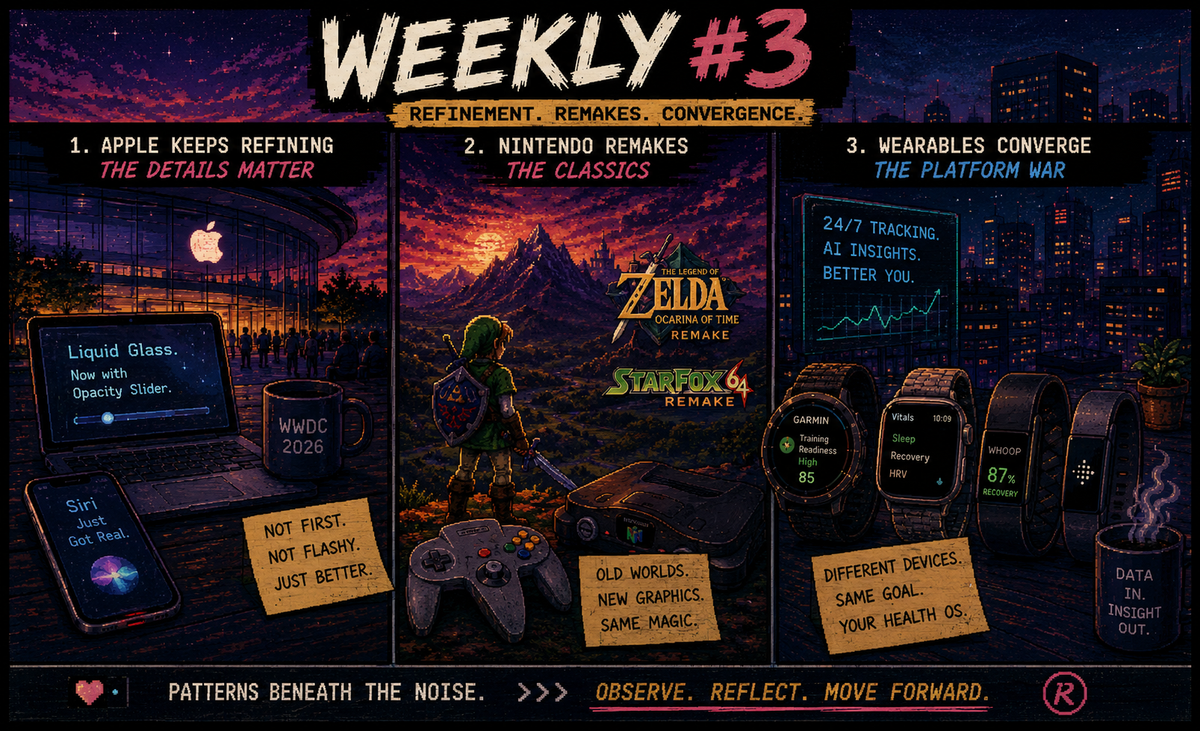
We had WWDC. We had a Nintendo Direct. And that was only by Tuesday. Somewhere in the middle of all that, yet another fitness wearable entered the chat.
As I experienced these headlines in real-time, several common themes started to emerge:
Refinement. Remakes. Convergence.
Apple spent WWDC refining everything from Siri to Liquid Glass. Nintendo reminded us that some classics are worth revisiting with not one, but two beloved N64-era remakes on the horizon. And Google joined the increasingly crowded wearable arms race with a screenless tracker aimed squarely at a market that seems determined to become more like itself every year.
Different companies. Different industries. The same pattern.
Technology loves to talk about invention. This week felt much more focused on iteration.
Let's get into it.
🍎 Apple Does Apple Things
Apple did it again. They went full Apple.
What does that mean exactly?
It means they spent an entire WWDC refining things they'd already announced.
Let's rewind.
WWDC 2024 was the big AI reveal. Sorry, Apple Intelligence reveal.
That was when Apple introduced its broader AI strategy, its partnership with ChatGPT, and perhaps most importantly, a wildly ambitious new version of Siri.
The promise was clear: Siri would finally become the intelligent assistant Apple had always envisioned.
Then... not much happened.
Or at least not all of it.
The industry moved on. Apple got criticized. Rightfully so. The promised Siri never fully materialized.
Fast forward to WWDC 2025.
Two words.
Liquid. Glass.
I'll be honest. I loved it.
Apparently my ADHD brain is incapable of resisting a major iOS redesign. Give me new animations, new icons, and a completely refreshed visual language and I'm immediately interested.
That said, I completely understood the criticism.
Sometimes Liquid Glass felt a little too liquid. A little too glassy. A little too eager to prioritize aesthetics over readability.
Which brings us to WWDC 2026.
Two new words. Opacity. Slider.
So what is it now? Liquid? Glass? Something in between? We get to decide.
And honestly, that feels like the perfect summary of this year's event.
Apple spent the last year refining nearly every aspect of the experience they introduced previously. Not abandoning the vision. Not pivoting. Refining.
The interfaces are more usable and the AI experiences are more grounded.
Instagram has already begun adopting elements of the refreshed design language, a reminder that Apple still exerts an almost gravitational pull over the broader software ecosystem.
And perhaps most notably, Apple finally demoed the new Siri.
Not a concept. Not a promise. A demo.
Which feels like a company that learned something from the last two years.
The rest of the industry remains locked in an AI arms race measured in benchmarks, model releases, and increasingly absurd capability demos.
Apple continues to ask a different question: How do we make this useful for normal people?
That's a much less exciting question.
It's also the question that matters when your products are used by billions of people.
Working at OpenAI, it's easy to become convinced that every six months represents a permanent shift in what's possible.
New models. New benchmarks. New capabilities.
The frontier moves fast.
Watching WWDC this week was a reminder that technological capability and mass adoption are not the same thing.
One moves at the speed of research. The other moves at the speed of humans.
You can't move a user base this large overnight. You can't retrain billions of habits every six months. You can't expect normal people to live on the same adoption curve as power users, developers, and technology enthusiasts.
So Apple does what Apple has always done.
It waits. It refines. It ships. Then it refines again.
Was WWDC 2026 groundbreaking? Not really.
But I found myself leaving with something I've increasingly felt watching Apple over the years.
Respect.
Not because they move the fastest, but because they understand exactly how slowly most people actually move. And perhaps that's why this WWDC felt particularly significant.
Because it also marks the end of an era.
Earlier Apple announced that Tim Cook would step aside as CEO this fall, with John Ternus taking over leadership of the company while Cook remains involved as chairman.
In many ways, this felt like the final Cook-era WWDC.
And if that's true, it's a fitting one.
Cook's Apple was rarely first.
It was often late. Sometimes frustratingly so.
But it was also extraordinarily disciplined. Cook is after all a storied and wildly talented supply chain wizard.
While much of the technology industry spent the last decade chasing the next thing, Apple spent much of it refining the things it already had.
Which makes Ternus one of the most fascinating executives in technology today.
He's a hardware leader inheriting a company navigating perhaps the largest software transition since the smartphone itself.
AI will define much of the next decade.
The question isn't whether Apple participates. The question is whether Apple can continue doing what Apple has always done:
Moving slower than everyone else.
And somehow still arriving exactly where it needs to be.
🗡️ The Future Keeps Digging Through the Attic
Up next is Zelda.
Which honestly I wanted to lead with.
But as a burgeoning technology blogger who insists he'll keep writing whether anyone reads this thing or not, I still had to start with Apple. They have a few more users than Nintendo.
So now we're going niche.
Hello, fellow Zelda fanatics.
Quick check-in.
I'm turning 37 in two weeks.
That means I was 9 years old when The Legend of Zelda: Ocarina of Time launched. 9 years old when I watched what felt like the future of gaming unfold in front of me. 9 years old when I experienced the utter frustration that was the Water Temple.
And now, somehow, I'm staring down the possibility of revisiting that same world nearly three decades later.
Nintendo is finally doing the thing we all knew they would eventually do.
They're remaking Ocarina of Time.
Frankly, many of us thought they would have done it years ago. Though in hindsight, I'm glad they waited until the Nintendo Switch 2 arrived with hardware capable of doing Hyrule justice.
Ah, nostalgia.
Technology loves to talk about innovation. Humans seem to love revisiting things they already know they enjoy.
The reaction to this announcement has been fascinating.
The hardcore fans are ecstatic. One of my favorite Zelda creators looked like he was moments away from ascending into another plane of existence during his reaction video.
Everyone else had roughly the same response:
"We already seen fan-made Unreal Engine demos of this for years..."
Fair.
But I think that misses the point.
The appeal isn't that Nintendo can remake Ocarina of Time. It's that Nintendo is remaking Ocarina of Time.
The company that created it. The company that understands why it mattered. The company that has spent decades carefully protecting one of gaming's most beloved worlds.
And in true Nintendo fashion, they managed to be the worst kind of teaser.
No gameplay. No systems. No mechanics.
Just roughly a minute of Link asleep while the Triforce flashed on his hand.
Objectively? Very little happened.
Emotionally? I was all in.
Which brings me back to a theme that's quietly emerged across all three stories this week: refinement.
Apple refining Siri and Liquid Glass.
Nintendo refining one of the most beloved games ever created.
An entire wearable industry refining itself into increasingly similar products.
Technology often celebrates invention. Consumers often reward familiarity.
Maybe nostalgia isn't really about the past. Maybe it's about trust.
People know Ocarina of Time is good. People know how it made them feel.
In a world increasingly flooded with new content, new platforms, new AI tools, and new experiences, certainty has value.
The classics still slap.
And while Nintendo may be playing it safe, perhaps that's exactly why people are so excited.
Sometimes we don't need the next big thing. Sometimes we just want to revisit an old favorite with better graphics.
And as someone who spent far too much time wandering Hyrule as a kid, I'm perfectly okay with that.
Now if you'll excuse me, I have a birthday coming up and Nintendo appears determined to make purchasing decisions on my behalf.
⌚ Everyone Is Becoming Everyone Else
Thankfully I have at least two weeks before Nintendo can convince me to spend money on Star Fox and we still don't know when the Ocarina of Time remake is actually arriving.
So let's talk about the other ever-present topic this week.
Fitness wearables.
And yes, we just talked about AI health coaches last week.
Then Google went and released the Fitbit Air.
Here's the thing.
I've tried most of the major wearables at one point or another. Apple Watch. Garmin. Whoop. Various Fitbits over the years.
And now I'm doing it again.
My Fitbit Air is due to arrive later today. Maybe I should start doing gadget reviews.
One thing at a time, Keith.
What caught my attention wasn't necessarily the hardware itself.
It was the positioning.
The Fitbit Air is already being labeled as a "Whoop killer."
And maybe it is. But I think that's missing the bigger story unfolding in real time.
Convergence.
Every wearable company is becoming every other wearable company.
A few years ago the categories were easy.
Apple made smartwatches.
Garmin made athlete watches.
Whoop made recovery trackers.
Fitbit counted steps.
Simple.
Today?
Whoop wants serious athletes.
Garmin wants serious athletes too, though it offers plenty of lower-cost entry points for people just getting started.
Apple wants to keep you inside its walled garden.
Google wants a piece of everything.
Oura wants to be the independent, fashion-forward, discreet tracker built around the ring form factor.
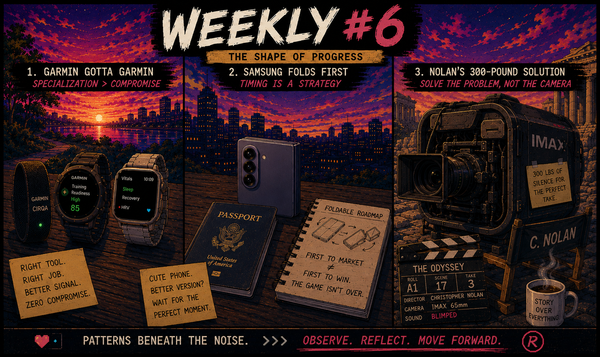
And apparently Garmin is rumored to be developing the Cirqa, a screenless companion device that sounds suspiciously similar to the category Whoop helped popularize.
Everyone is copying everyone.
I don't necessarily mean that as criticism.
In many ways it's exactly what healthy competition should produce.
Companies observe what customers value and adapt.
The result is that every wearable manufacturer seems to be converging toward the same destination.
24/7 tracking.
Recovery insights.
Sleep coaching.
Training recommendations.
Health monitoring.
AI-generated summaries.
The same goals.
The same promises.
The same vision.
The hardware is becoming less interesting.
The software is becoming more similar.
And increasingly, the differentiator isn't what data these devices collect.
It's how they interpret it.
The irony is that all of these companies are collecting extraordinary amounts of information about our lives.
Heart rate. Sleep. Recovery. Stress. Training load. Readiness. Body battery. Energy scores.
Whatever score they're calling it this quarter.
And what do most people ultimately want?
Three answers. Am I healthy? Why am I so tired? Should I work out today?
Thousands of data points in pursuit of three very human questions.
Now, I will admit that Google's involvement raises a separate question.
Trust.
The company says health data collected through Fitbit remains separate from its advertising business. That's undoubtedly the right position and frankly the only acceptable one.
Still, health data occupies a uniquely personal category of information.
People care deeply about who has access to it.
As they should. But even that concern points back to the larger story.
These companies aren't simply competing to sell us watches, rings, bands, and subscriptions.
They're competing to become our health operating system.
The device we wear every day. The app we check every morning.
The source we trust when making decisions about our bodies.
The Fitbit Air is simply the latest entry in that race.
As for how it compares to my Apple Watch Ultra or Garmin Forerunner 970?
I'll let you know.
You can safely assume future Retrograde issues will contain updates from what has become an increasingly ridiculous collection of devices strapped to my body.
What seems clear is that every company in this category is chasing the same prize.
Not better hardware. Not better sensors. Not even better AI. They're chasing the holy grail of health technology:
Useful insights.
The one device that consistently helps people make better decisions.
The one device people never take off.
How do you think it plays out?