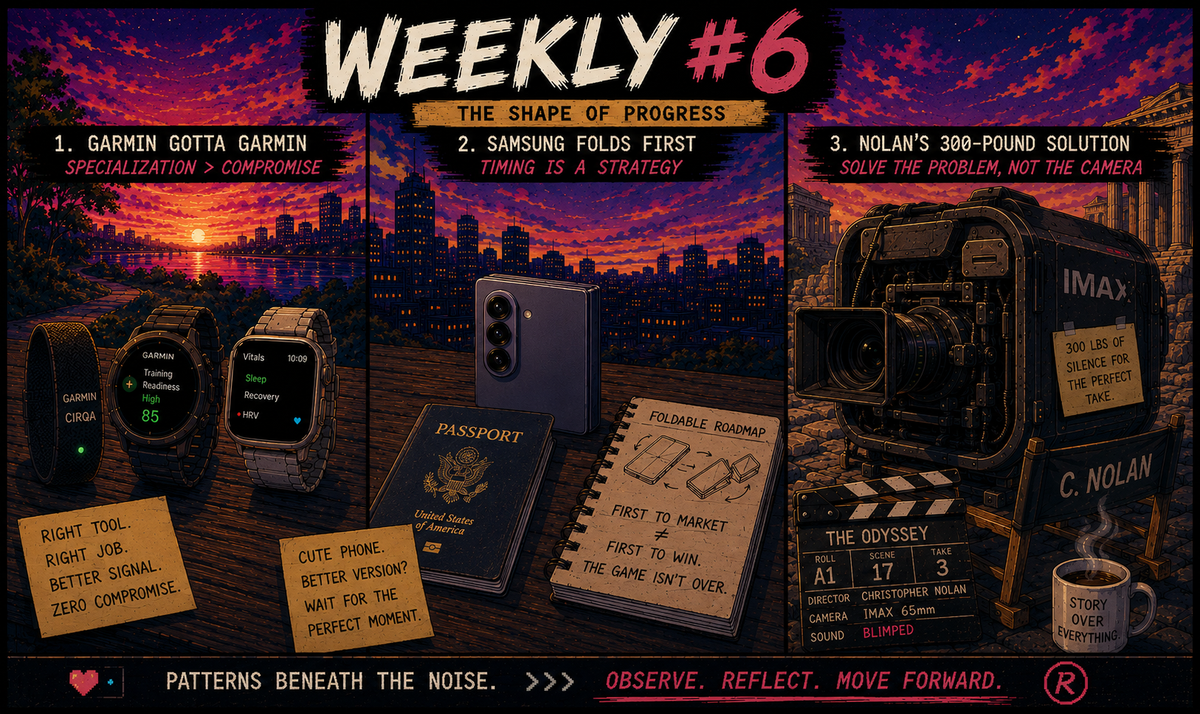
Weekly #6 — The Shape of Progress

Well...
That accidental hiatus lasted a little longer than intended.
Turns out preparing for a move to North Carolina, and attempting to remember which box I packed my coffee grinder in is surprisingly incompatible with a weekly writing schedule.
But we're back, baby.
Better yet, I will soon have a little more breathing room. More time to read. More time to think. More time to notice the strange little patterns hiding underneath this wonderfully chaotic industry. More on all of that soon.
This week we're looking at three very different stories, a new fitness band from Garmin, Samsung's latest foldable gamble, and Christopher Nolan's wonderfully stubborn approach to filmmaking.
Different industries. Different technologies.
The same underlying question.
What does progress actually look like?
Let's get into it.
Story #1 — Garmin Gonna Garmin
"Whoop killer."
That's the phrase that gets thrown around every time another screenless fitness band hits the market. The idea is simple: disappear into the background, quietly collect mountains of health data, and stay out of your way.
Personally? I'm a fan.
I've become increasingly convinced there isn't a wrist-based wearable that excels equally as both a smartwatch and a dedicated fitness tracker.
That's why, to the confusion of strangers everywhere, I wear a Garmin Forerunner 970 on my left wrist and an Apple Watch Ultra on my right.
The Apple Watch gives me everything Apple does exceptionally well: Wallet, notifications, music, Home controls, Siri, and all the little conveniences that make it feel like a tiny extension of my phone.
The Garmin does what Garmin has quietly become the best in the business at: tracking my health and athletic performance with an almost obsessive level of detail. Heart rate. HRV. Sleep. Respiratory rate. Training readiness. Running dynamics. Cycling metrics. If there's a physiological signal worth measuring, Garmin is probably already graphing it somewhere.
Yes, I realize this is an aggressively nerdy setup.
But it also reflects something I don't think the industry has fully acknowledged yet.
The smartwatch and the sports watch are converging far more slowly than we expected.
Several weeks ago I spent some time wearing Google's Fitbit Air.
I'll give Google its flowers: I think it has the most intuitive AI coaching experience I've used so far. The recommendations felt contextual instead of generic, and for the first time I found myself thinking, "Oh... this actually understands what I've been doing."
Then it told me I'd burned enough calories to justify a second dinner.
Just like Fitbit devices I wore nearly a decade ago, I found the calorie estimates wildly optimistic, often reporting numbers that were 40–50% higher than what both Garmin and Apple estimated. And yes, Apple is generally more generous than Garmin, but Fitbit still feels like it's grading on a curve.
The coaching impressed me but the data didn't earn my trust.
Which brings us to Garmin's newest gadget: Cirqa.
And yes...
I've already ordered one.
Not because I think it'll replace anything I'm wearing today, but because I don't think this gap between smartwatch and dedicated fitness wearable is disappearing anytime soon.
Technically, someone could build the perfect device that does both.
Commercially?
I'm not so sure.
The people who obsess over VO₂ max, recovery scores, lactate thresholds, and training load aren't necessarily the same people who care most about replying to texts from their wrist or unlocking their front door with Apple Wallet.
Human nature is funny like that.
We don't buy technology based solely on what it can do. We buy it based on what we care about.
And companies, understandably, follow those incentives.
Maybe one day those worlds converge.
For now, specialization still seems to be winning.
I'll report back in a few weeks, assuming Garmin's estimated 1–3 week shipping window behaves itself, with some real thoughts after living with Cirqa for a while.
Story #2 — Samsung Folds First (Again)
In case you missed it Samsung announced an updated form factor for their existing line of foldable smartphones with a passport shaped device.
So they won... again Right?
I don't know, because Apple hasn't even sat down at the table yet.
As usual, Apple is "late" to the party. But at this point, that's hardly news, it's practically the business model. Foldable phones have been around for years now, yet Apple has remained conspicuously absent while Samsung, Google, Motorola, and others have spent the better part of a decade refining hinges, displays, software, and figuring out what this category actually wants to be.
Meanwhile, Apple's famously secretive product roadmap isn't quite as mysterious as it once was. Supply chains can only hide so much, and the operational machine Tim Cook built, arguably his greatest legacy, has become remarkably predictable. Assuming Mark Gurman and the rest of the rumor mill are right, this Fall's iPhone "Ultra" is expected to be Apple's first foldable.
Then Samsung did something interesting.
Instead of waiting for Apple to introduce what many expected would be its defining take on the category, Samsung got there first with a thinner, wider, "passport-style" foldable that, by nearly every account, feels fantastic in the hand.
And almost if not exactly the updated form factor we suspect Apple is going for.
Which raises a question.
Did Samsung just win... or did they fold a winning hand? See what I did there? 😉
Here's what I keep coming back to.
Apple being late isn't the story.
Apple watches. Apple waits. Apple refines. Whether you love or hate that strategy, it's been remarkably consistent for the better part of two decades.
Samsung, on the other hand, had an opportunity to play a different game.
Imagine an alternate timeline.
Apple unveils its first foldable to all the fanfare you'd expect.
A month later Samsung walks on stage and says,
"Cute phone. Here's the better version."
Even Mark Gurman, who's reported extensively on Apple's plans, has suggested Samsung still holds the edge in display technology. Imagine pairing that technical advantage with the satisfaction of immediately one-upping Apple's long-awaited debut.
That would've been delicious.
Instead, Samsung blinked first.
Maybe they couldn't move their launch event. Maybe product cycles made the decision for them. Maybe shipping sooner was simply the right business call.
But I can't help wondering if they optimized for being first when they could have optimized for being unforgettable.
It's another reminder that technology companies are still run by humans, and humans have an almost irresistible urge to be first.
The funny thing is... this industry has spent decades proving that first and best aren't the same thing.
For better or worse, I'm deeply embedded in Apple's ecosystem, so I'll probably be waiting for the inevitable iPhone Fold, or Ultra, or whatever marketing ultimately calls it, to decide whether a foldable belongs in my pocket.
Until then, I'm less interested in who announced first than who ultimately ships more devices.
Because history tends to remember category leaders a lot longer than category starters.
Story #3 — Nolan's 300-Pound Solution
Last weekend Maggie and I went to see The Odyssey.
Now, there are plenty of cultural conversations happening around the film—some thoughtful, some utterly ridiculous, and some predictably racist. If you're curious where I land on all of that... you'll have to follow my delightfully unhinged Instagram account. 😬
I'm here for something else.
IMAX.
It's funny to think about now, but I'm old enough to remember visiting the IMAX theater at Greenfield Village outside Detroit. Back then the screen felt impossibly enormous. The cameras that made those images possible were equally enormous, and while they've become dramatically better over the decades, one problem stubbornly remained.
They were loud as hell.
Not "turn the volume up" loud.
Mechanical. Relentless. Loud enough that shooting intimate dialogue scenes with them simply wasn't practical.
The obvious assumption would be that we'd have to wait for quieter cameras.
Christopher Nolan had a different idea.
Nah.
Instead of redesigning the camera itself, IMAX engineers built what they call a blimp around it—a roughly 300-pound sound-dampening enclosure that lets the exact same camera sit inches from an actor's face without drowning out the dialogue.
That's such an unapologetically blunt engineering solution.
The camera wasn't the problem.
The noise was.
So solve the noise.
It's not particularly glamorous.
It's certainly not AI-powered.
It won't keynote well.
But it worked.
I love that.
Because it reminds me that engineering isn't always about making something smaller, faster, or more complicated. Sometimes it's about identifying exactly what needs solving—and solving only that.
Christopher Nolan famously doesn't own a smartphone. Whether that's true asceticism or just the world's greatest commitment to staying focused, it feels strangely consistent with the way he makes films. He doesn't chase technology for its own sake. He uses it when it serves the story and bends it to his will when it doesn't.
There's a lesson in that.
This week we've looked at Garmin removing screens, Samsung refining foldables, and now Nolan wrapping a decades-old camera in what is essentially a very expensive, very heavy soundproof box.
Three completely different industries.
Three completely different solutions.
One recurring pattern.
Progress doesn't always arrive through invention.
Sometimes it arrives because someone refuses to compromise, looks at an imperfect tool, and says,
"No... we'll find another way."
Bravo, Mr. Nolan.
And bravo to the engineers who had the wonderfully unsexy idea of putting a 300-pound box around a camera so one of our generation's greatest filmmakers could tell a 3,000-year-old made up tale in a way we've never seen before.