Weekly #2 - The Apple Car that Ferrari Built, AI Health Coaching and the Re-Return of Personal Computing

Alright, we're really doing it.
Weekly #2.
Here we are.
Here we fucking go.
I had a lot of fun thinking through this week's topics and I'm genuinely excited by the possibility that a handful of you might find them entertaining, useful, thought-provoking, or at the very least a decent way to procrastinate for a few minutes.
For our second real post, I'm looking at three developments across the broader technology, AI, and gadget landscape:
🚗 Heeeerrrreeee's Jony... and Ferrari.
⌚ What's really happening in fit tech and the rise of AI health coaches.
💻 The re-return of personal computing.
At first glance these seem like completely unrelated stories.
A Ferrari EV.
Fitness wearables.
AI-powered computers.
But as I dug into them, I kept finding the same pattern underneath.
Technology keeps pushing us toward an idealized future.
Then reality shows up and reminds us what people actually wanted all along.
Let's dive in.
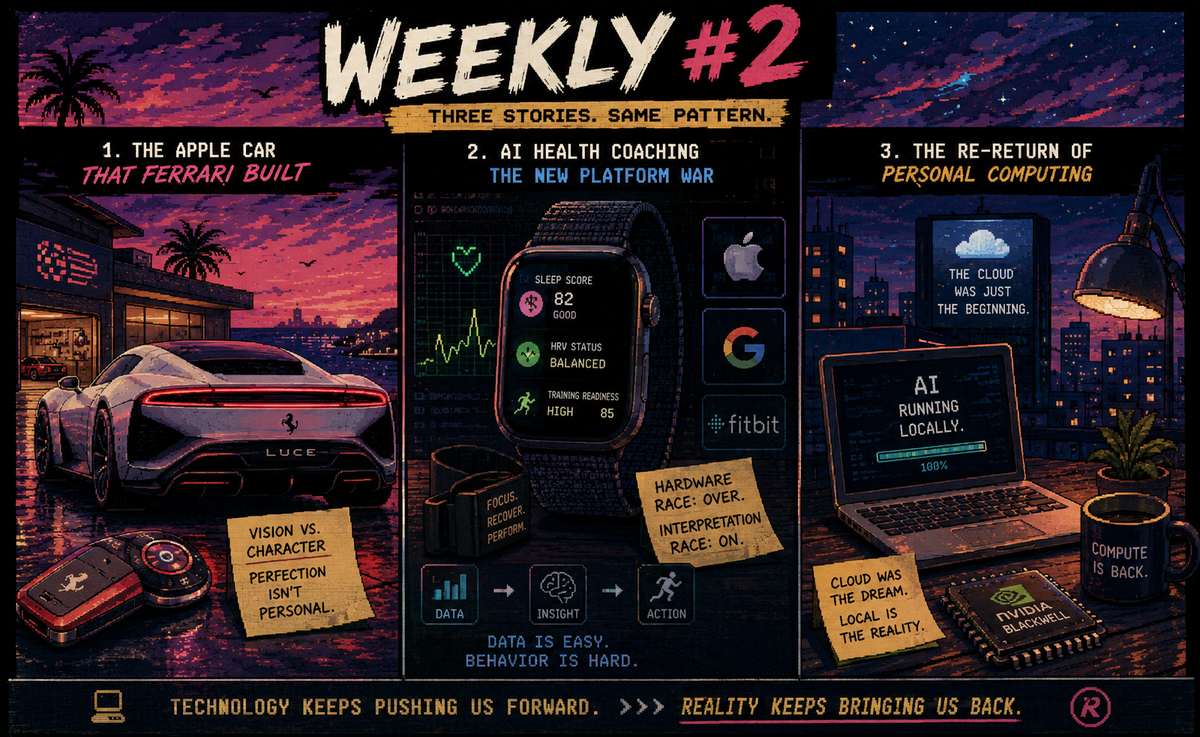
1 . The Apple Car That Ferrari Built
I remember back in 2014 working at a fledgling "data as a service" startup. Today we'd call it a data enrichment company. At the time, I was employee number eight, we were pre-$1M in revenue, and nobody really knew what we were doing. What a ride.
One thing our platform was exceptionally good at was tracking talent movement between companies. Around that time, a fascinating battle was brewing between Tesla and Apple.
The rumors surrounding Apple's automotive ambitions were impossible to ignore. Apple was supposedly building a reimagined electric vehicle rooted in its famous design ethos. Meanwhile, Tesla was rapidly becoming one of the most important—or at least most discussed—companies in technology.
Using our data, I tracked employees moving between the two companies. Tesla to Apple. Apple to Tesla. Over and over again. There were dozens of examples. Something was happening.
For years, the Apple Car became one of technology's great "what if" stories.
Then it died.
Fast forward to 2026.
We never got the Apple Car.
Instead, we got the Ferrari Luce.
The reaction online has been fascinating.
First, almost everyone agrees the interior is stunning. The materials, the lighting, the controls, the details. It's gorgeous. Frankly, if Jony Ive had actually designed a car, this is probably where I would have wanted his influence concentrated.
Second, nearly everyone seems confused by the exterior.
One reporter described it as looking like a Honda EV concept.
I hate how much I agree with that assessment.
Third, Ferrari appears to have genuinely pursued an ambitious vision. By its own admission, the company wanted to build the EV that "only Ferrari could build."
And in many ways, they succeeded.
The specifications are absurd.
The engineering is remarkable.
The individual motors for each wheel are crazy town cool.
The key is ridiculous in the best possible way. The colors shift. The startup controls illuminate dramatically. The entire experience feels theatrical and intentional.
It's incredibly impressive.
And yet...
The exterior still doesn't look like a Ferrari.
At least not the Ferrari many people have in their heads.
Which raises a more interesting question.
What happened?
My theory is simple.
Ferrari lost touch with what makes a Ferrari feel like a Ferrari.
Now, before the car enthusiasts show up in my inbox, I should be clear: I am not a car guy. I don't even own a car.
But I do spend a lot of time thinking about products.
And we've seen this pattern before.
A company becomes wildly successful.
The company develops a strong point of view.
That point of view turns into a design philosophy.
That philosophy becomes an identity.
And eventually, the company becomes so focused on executing its vision that it starts drifting away from the reasons customers fell in love with the product in the first place.
We've seen versions of this story before:
- Apple's butterfly keyboard prioritized thinness over usability.
- Snapchat's redesign prioritized vision over user behavior.
- New Coke optimized the formula and forgot the emotional attachment.
- Sonos recently learned the hard way that modernizing an experience isn't the same thing as improving it.
Different products.
Different industries.
Same trap.
Sometimes that looks like software companies removing features users rely on because the product team wants a cleaner interface.
Sometimes it looks like social networks optimizing for engagement while making the experience worse.
Sometimes it looks like companies becoming obsessed with elegance at the expense of personality.
The Ferrari Luce feels like it might belong in that category.
Because what people love about Ferraris isn't perfection.
It's emotion.
It's drama.
It's excess.
It's the feeling that somebody in Maranello looked at a sensible decision and intentionally chose violence instead.
The irony is that Ferrari may have accidentally built the closest thing we'll ever get to the Apple Car.
Not literally.
Philosophically.
A vehicle optimized around design purity, technical excellence, and a vision of the future.
The problem is that customers don't always fall in love with visions.
They fall in love with character.
Would I drive one?
Absolutely.
Would I do my absolute best Lewis Hamilton or Charles Leclerc impression behind the wheel?
Without question.
Did Ferrari swing, miss, and faceplant a little bit on the exterior?
Also yes.
The lesson here isn't about cars.
It's about what happens when companies become so focused on building the perfect version of something that they forget why people loved the imperfect version in the first place.
The future has a funny way of looking a lot less exciting when it stops feeling familiar.
2. All The AI Health Coaches
Fitness technology fascinates me.
Partially because I'm a giant nerd.
Partially because I'm an endurance athlete.
And partially because over the last decade I've probably put thousands of miles on nearly every major fitness platform while running and cycling.
Garmin.
Apple.
Whoop.
Fitbit.
Multiple generations of devices from most of them.
For the longest time it was abundantly clear that certain companies were simply better at hardware.
Looking directly at you, Garmin.
My true fitness technology love.
For years Garmin felt like the only company consistently producing data that athletes actually trusted. While everyone else was trying to figure out wrist-based heart rate, GPS accuracy, battery life, and sensor quality, Garmin was busy building products for people who genuinely cared whether their workout data was correct.
Over time, though, the gap narrowed.
The sensors got better.
The batteries got better.
The algorithms got better.
The hardware got better.
You can still feel where each company's priorities are.
Garmin is a fitness watch with some smartwatch features sprinkled in.
Apple, even with the increasingly capable Ultra lineup, is still fundamentally a smartwatch with some fitness watch features sprinkled in.
And today?
I wear an Apple Watch Ultra most of the time.
Not because it's the best fitness watch.
It isn't.
I wear it because I need the smartwatch functionality. I like the ecosystem. I like the integrations. I like the ridiculous shortcuts and automations I've built that leverage large language models behind the scenes.
That's a story for another day.
When I'm training seriously outdoors, though, the Garmin still comes with me.
Especially when I want advanced running metrics, chest strap heart rate data, cycling power numbers, cadence sensors, and all the other nerdy things endurance athletes convince themselves are essential.
My personal preferences aside, Google recently launched the Fitbit Air, a product already being positioned as a potential "Whoop Killer."
I've been a Whoop customer.
Twice.
Both times I eventually left.
Not because it was bad.
I simply never found enough value to justify the recurring subscription.
Now Google arrives with an arguably better form factor, a similar screen-free experience, and the exact same thing technology companies love most:
A recurring subscription.
Google Health Premium.
Because apparently every product eventually becomes a software company.
Which brings me to the real story.
This isn't a hardware battle anymore.
It's an ecosystem battle.
It's a platform battle.
It's a distribution battle.
In Weekly #1 I wrote about Google's distribution advantage.
The same principle applies here.
I'm unlikely to switch to a Fitbit Air.
Not because it's worse.
Not because the sensors aren't good enough.
Not because the AI won't eventually improve.
I'm unlikely to switch because I'm an Apple user.
Apple has a moat.
Google has a moat.
Both companies make it incredibly easy to use products within their own ecosystem and incredibly frustrating to operate across ecosystems.
And that means the competition increasingly shifts away from hardware.
Which leaves us with the industry's newest obsession.
AI.
Bullishly, this is one of the categories where I think AI has genuine potential.
Not someday.
Today.
The existing implementations aren't particularly impressive.
Most AI coaching insights currently fall somewhere between "well written" and "painfully obvious."
Sleep more.
Recover better.
Don't overtrain.
Thank you, computer.
But the ingredients are finally there.
The hardware is good.
The sensors are good.
The data is abundant.
In theory, these systems should be capable of delivering genuinely useful guidance.
And yet the industry still seems oddly disconnected from reality.
Take sleep tracking.
A recent survey of more than 1,000 adults found that only 29% believed sleep tracking apps actually helped them prioritize sleep, while nearly 18% reported that tracking their sleep made them more worried about sleep itself.
Researchers even coined a term for this phenomenon years ago: orthosomnia.
The unhealthy pursuit of "perfect sleep" driven by wearable tracking devices.
Think about how absurd that is.
We built technology intended to help people sleep better.
Then researchers had to invent a medical-sounding term for people becoming anxious about their sleep scores.
The industry keeps assuming more data will solve the problem.
The evidence increasingly suggests the problem was never a lack of data.
It's a lack of understanding.
And we've seen this pattern before.
Technology pushes forward an ambitious vision.
The vision sounds compelling.
The reality turns out to be far messier.
Again.
And again.
And again.
To be honest, I rely less and less on my daily readiness scores, recovery scores, HRV trends, VO2 max estimates, and all the other metrics these platforms love to surface.
I'm still deeply interested in my actual performance.
How did the run go?
How did the workout feel?
Am I getting faster?
Am I getting stronger?
Those questions matter.
But I'm still waiting for a product that consistently turns all of this data into something genuinely useful.
The wearable industry spent a decade trying to measure us.
The next decade will be spent trying to understand us.
Whether these AI health coaches can actually do that remains an open question.
3. The Re-Return of Personal Computing
Fit tech is fighting platform wars.
Meanwhile Apple, Microsoft, Nvidia, Qualcomm, and just about everyone else are suddenly fighting chip wars.
Nvidia recently unveiled new AI-focused hardware.
Microsoft rolled out a new generation of AI PCs designed specifically to run AI workloads locally.
Locally.
What happened to "it's all in the cloud?"
Seriously.
I've spent the better part of my career explaining cloud computing to friends and family members who wanted to know where their photos lived, where their files lived, where their emails lived, and why they could suddenly access all of them from every device they owned.
The answer was always some variation of:
"The cloud."
And for a while, that was enough.
Computing became increasingly invisible.
The device in front of you mattered less.
The infrastructure behind it mattered more.
Storage moved to the cloud.
Applications moved to the cloud.
Photos moved to the cloud.
Music moved to the cloud.
Everything moved to the cloud.
Then AI showed up and suddenly everyone started talking about chips again.
Not apps.
Not software.
Chips.
Compute.
Memory.
Power consumption.
Local inference.
Latency.
Privacy.
It's almost as if intelligence has a way of making the cost of computing visible again.
And there are legitimate reasons for the shift.
Energy consumption.
Privacy concerns.
Data ownership.
Reliability.
The uncomfortable reality that sending every request to a massive data center somewhere in the world may not always be the most efficient solution.
Not to mention that technology companies would very much like to sell us new devices.
Thank you, capitalism.
What's fascinating is how familiar all of this feels.
For nearly two decades the industry pushed us toward increasingly cloud-centric experiences.
The future was supposed to be services.
Subscriptions.
Streaming.
Synchronization.
Computing that happened somewhere else.
Now, at the exact moment AI becomes the most important technology trend on the planet, we're seeing a renewed focus on the machine sitting directly in front of us.
The block of aluminum on our desk.
The laptop in our backpack.
The phone in our pocket.
I still remember a conversation with a friend in my late teens.
At some point he looked at his smartphone and said:
"Do you realize we're carrying computers in our pockets?"
He was right.
We just stopped talking about them that way.
The smartphone became so successful that we forgot it was a computer.
Today we have laptops powered by smartphone-class chips.
Phones with more computing power than the desktops many of us grew up using.
And AI models increasingly designed to run directly on those devices.
The personal computer never really disappeared.
It just became so ordinary that we stopped noticing it.
Now the industry seems determined to remind us.
That's what makes this moment feel so familiar.
After decades spent moving computing somewhere else, we're once again investing heavily in the machines closest to us.
Not because technology is moving backward.
Because intelligence turns out to be expensive.
Expensive in compute.
Expensive in energy.
Expensive in latency.
Expensive in privacy.
And once those costs become visible, people suddenly care where the work is happening.
History doesn't repeat itself exactly.
But it certainly rhymes.
The personal computer is back.
Not that it ever really left.
And as the industry chases what could become the next great "M1 moment," I can't help but wonder if the future of computing might end up looking surprisingly familiar.